

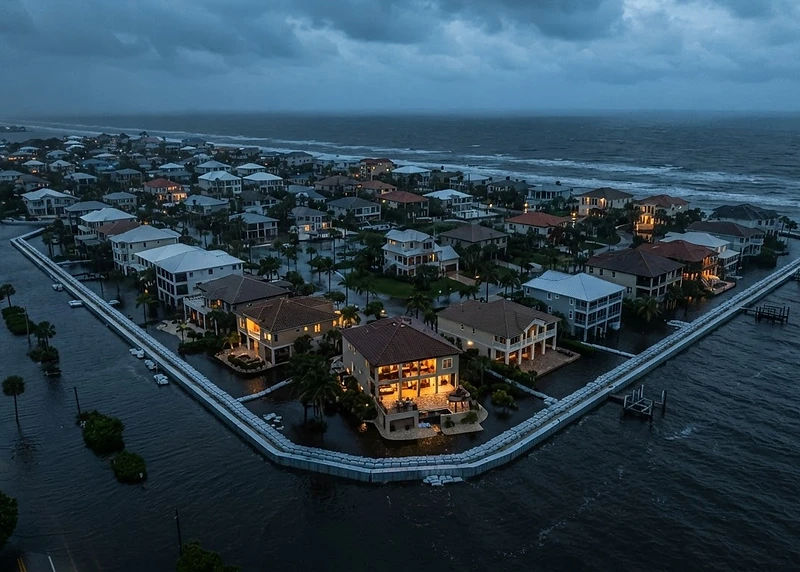
Storm surge is the abnormal rise in seawater level generated by a tropical cyclone's winds pushing ocean water onshore. It is not a wave. It is a dome of water, sometimes exceeding 20 feet in height, that advances inland with the force of a freight train. Along Florida's 1,350 miles of coastline, storm surge represents the single most destructive force a hurricane can unleash, capable of leveling homes, sweeping vehicles away, and inundating entire neighborhoods within minutes. For homeowners, understanding storm surge mechanics is essential to choosing the right flood barrier protection.
How Storm Surge Differs From Riverine Flooding
Many Florida homeowners confuse storm surge with ordinary flooding, but the two hazards behave very differently and require different engineering responses. Riverine flooding rises gradually as rainfall overwhelms drainage systems, giving residents hours or days to respond. Storm surge arrives suddenly and violently — the wall of water can push miles inland in under an hour, carrying debris, vehicles, and structural wreckage as battering rams. A flood barrier designed only for static water pressure will fail under the dynamic impact forces of surge. This is why Fortress Flood Protection barrier systems are engineered to resist both hydrostatic pressure up to 12 PSI and the kinetic impact of debris-laden surge water, a dual-threat standard that exceeds Florida Building Code requirements for coastal construction.
The velocity of surge water is what makes it lethal. A Category 4 hurricane can drive a 15-foot surge inland at speeds exceeding 15 mph. By the time the water reaches a home a mile from the coast, it still carries enough kinetic energy to breach standard doors and shatter windows. Permanent barrier systems address this by sealing every opening (doors, windows, vents, and garage entries) with marine-grade aluminum panels locked into permanently mounted tracks. The seal is watertight, the mounting is structural, and the system deploys in minutes when a storm warning is issued.
Florida's Storm Surge Risk Zones
Florida's geography makes it uniquely vulnerable to storm surge. The state's shallow continental shelf allows surge to build height as it approaches shore, and its peninsular shape means storms can approach from both the Atlantic and Gulf coasts. FEMA designates coastal areas as Zone VE — the highest surge risk category — where wave heights of three feet or more are expected atop the surge itself. Properties in Zone VE require the most robust barrier engineering, typically full-perimeter systems rated for both surge height and wave impact. Even properties several miles inland can face significant surge risk along tidal rivers, canals, and low-lying coastal plains. A professional surge risk assessment maps a property's elevation, distance to open water, and evacuation zone status to determine the correct barrier specification.
Engineering a Barrier Against Surge
Designing a barrier to stop storm surge is fundamentally an exercise in structural engineering. The system must resist three distinct forces simultaneously: the hydrostatic pressure of standing water against the barrier face, the hydrodynamic impact of moving water and debris striking the surface, and the uplift force of water attempting to flow beneath the barrier. Fortress Flood Protection engineers model each of these forces for a property's specific surge scenario and specify panel thickness, track anchoring depth, and seal compression ratings accordingly. The 6061-T6 aluminum alloy used in Fortress Flood Protection panels offers the optimal balance of strength, corrosion resistance, and weight: strong enough to stop a surge, light enough for a homeowner to deploy without assistance. Every system is fabricated in the United States under ISO 9001 quality standards and carries a lifetime structural warranty.